There are 5 key elements within the Lenstar device: biometer, IOL calculator, keratometer, pachymeter and pupillometer, which have so far been part of separate devices, which is why the recording took much longer. The device is used to provide the ophthalmologist with complete biometrics of the patient’s eye, including lens thickness (LS), retinal thickness (RT), anterior chamber depth (ACD), axial length (AL) and all of this, and more, in just one measurement. Data such as keratometry and axial length of the eye are important for determining intraocular lenses that are implanted during cataract surgery, while measuring central corneal thickness (CCT) is useful in diagnosing glaucoma, and crucial in deciding on laser vision correction. The platform also has its significance in the planning of the implantation of toric intraocular lenses.
Using standard formulas (Hoffer Q, Holladay I, SRK-T, Haigis and the new Olsen formula extremely useful in predicting IOLs), calculations for modern multifocal and toric lenses are obtained, which allows us to provide the patient with perfect vision without or with minimal use of glasses, as well as the correction of astigmatism.

Lenstar is the first on the market to provide the ability to accurately measure the thickness of the lens, and with the above-mentioned Olsen IOL formula, the possibility of postoperative refractive error is minimal. All this data is invaluable in modern ophthalmic practice, and makes Lenstar more complete and faster in data collection than other optical and ultrasonic biometers.
The camera is suitable for imaging eyes with implanted artificial lenses, with the lens removed (aphakia) and for imaging eyes filled with silicone oil. It is also used in patients who have undergone laser vision correction, and in whom special attention is needed on keratometric data due to an altered cornea. In this case, Lenstar uses the formulas Shammas No-History, Masket and Modified Masket, which make it easier for the surgeon to calculate the IOL after previously performed refractive surgery. Lenstar, the only similar apparatus currently in use in the world, contains all of these formulas in its database. It improves refractive outcome by excluding the risk and danger of transcriptional errors.
Lenstar measures keratometry in a unique way compared to other similar devices, in a double zone at 1.65mm and at 2.3mm, thus ensuring It is measured at 32 points, thus reducing the chance of error to a minimum. One Lenstar image consists of 16 separate images of the whole eye and 4 separate keratometric images, taken on 2 concentric rings along the entire length of the visual axis.

The device uses an intelligent system for detecting the patient’s fixation, which achieves greater reliability of the measured parameters. During the scan, the patient focuses on the red beam in front of the eye to be scanned. If the patient loses fixation or blinks, the Lenstar notices it, pauses the recording and automatically resumes the recording when the patient focuses on the red rays again. And finally, Lenstar optical biometer imaging is completely painless and direct contact of the device with the patient’s eye is not required. The device does not radiate radiation and is safe for all patients.
Perfect Vision is an Eye Laser Surgery Center located within the Kuća zdravlja Polyclinic, headquartered in Subotica.
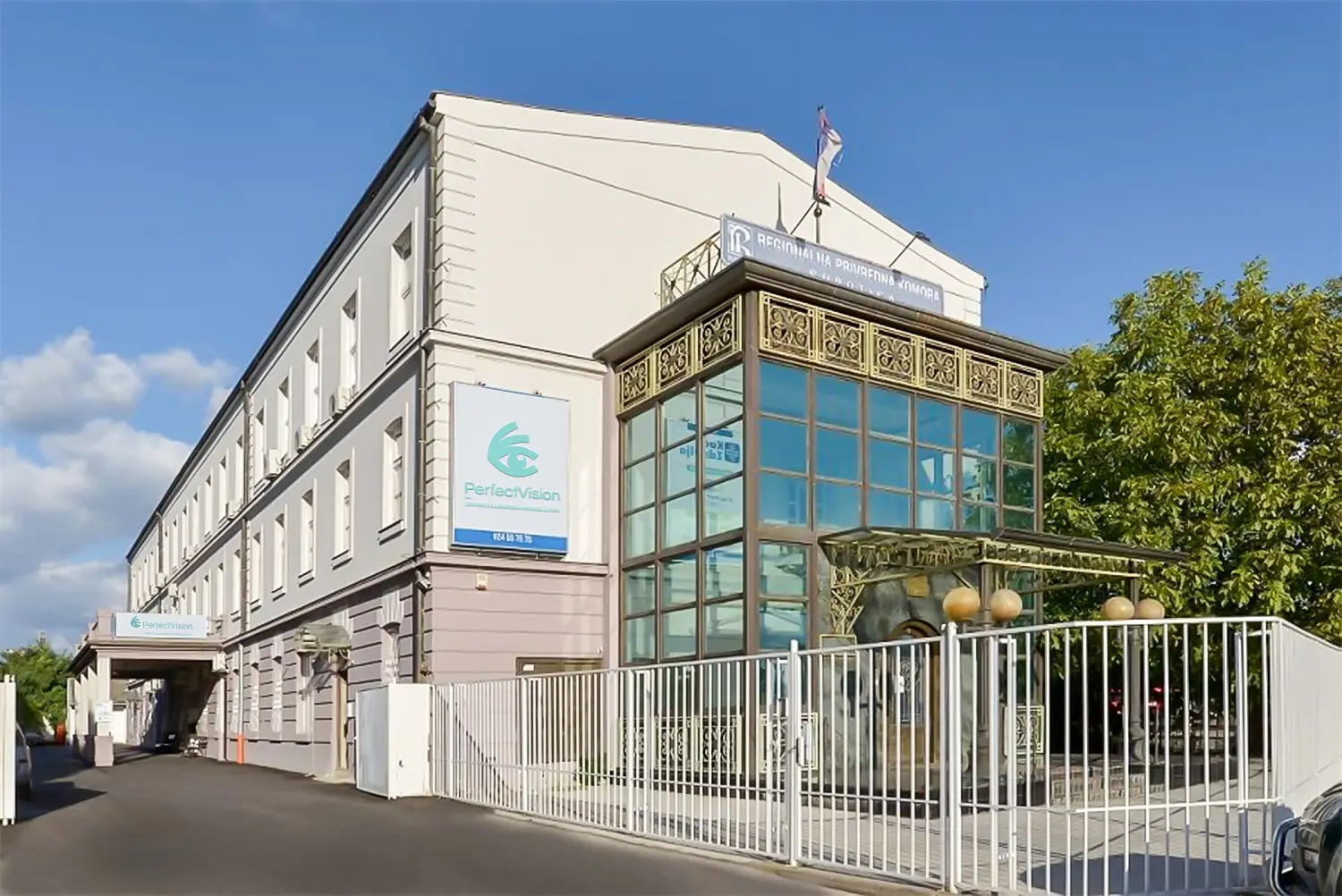


Perfect Vision is a Center for Laser Eye Surgery, located within the Polyclinic House of Health, based in Subotica. Visit us!


We have an ISO certificate according to ISO 9001: 2015, registration number 12 100 59137 TMS for the area of Diagnostic, Conservative and Surgical Ophthalmic Services, issued by the certification body TÜV NORD CERT GmbH.