Meibomian gland expression – the key to the health of your tear film and clear vision
What are Meibomian glands? Meibomian glands are small glands located in the eyelids that produce the lipid (fatty) component of…

Laser removal of dioptres is the most frequently performed operation at the request of patients, and in three decades, millions of people have permanently gotten rid of glasses or contact lenses in this way, which speaks volumes about how safe and effective this operation is.
We have selected some of the most common questions asked by our patients in order to dispel some prejudices and fears, said Dr. Branka Ivošević, Chief Executive Officer of the Pefect Vision Laser Eye Surgery Center.
1. Does dioptre removal by the PRK method (photoreactive keratectomy) remove the dioptre permanently?
In most cases, the dioptre is removed permanently, in a small percentage, a smaller part of the dioptre may return over time, which can be easily removed with retreatment.
2. Can astigmatism be removed with a laser?
Apart from plus and minus diopters, i.e. farsightedness and shortsightedness, the laser can also remove astigmatism – the irregular curvature of the cornea up to +/-5.0 diopters.
3. Is the PRK method of laser dioptre removal safe?
By using modern lasers that have an eye tracking system for tracking the eye, the laser emits UV rays, according to a predefined schedule at a speed of 2.5 seconds per dioptre without the possibility of any error, removes the given dioptre.
4. Can I remove diopters with a laser if I do not have stereo (spatial) vision?
People who are visually impaired have proportionally reduced stereo vision, and after laser dioptre removal in some cases stereo vision can be improved to a lesser extent, but just as low vision is not treated with a laser, the same applies to stereo vision.
5. What tests and imaging do I need to do in preparation for laser dioptre removal?
The examination begins with an anamnesis – a conversation with the patient during which we learn the necessary details about the dioptre, whether the patient wears glasses or contact lenses, whether he suffers or has suffered from any eye diseases or other diseases, whether he has had previous eye injuries and surgeries. After that, we record diopters on narrow and wide pupils, perform topography (mapping of the cornea) and imaging of the fundus (optical coherence tomography).
6. Is the examination for laser diopter removal painful and how long does it take?
This examination is completely safe and painless and lasts about 2.5 hours.
7. How long are the results of the examination valid?
We advise patients if the operation is prolonged by more than 6 months compared to the date of the examination, to perform the examination again.
8. For this type of surgery, it is necessary that the diopter is stable, what should I do if my diopter varies?
It is necessary for the diopter to be stable for one year before the operation.
9. What eye and eye diseases and conditions might make me not a suitable candidate for this surgery?
Some of the contraindications for laser diopter removal surgery are a thin cornea, corneal diseases such as keratoconus, corneal inflammation (keratitis), corneal scars, extremely dry eyes, clouded lens (cataract), diseases of the fundus and connective tissue diseases called collagenosis.
10. Can I perform laser dioptre removal surgery after strabismus surgery and vice versa?
Laser dioptre removal surgery can be performed after complete recovery from strabismus surgery and also after laser dioptre removal when vision and condition of the cornea are completely stabilized, i.e. after at least 4 months, strabismus surgery can be planned.
11. Can a laser surgery to remove dioptres be performed in patients with Hashimoto’s thyroiditis?
Well-controlled Hashimoto’s thyroiditis is not an absolute contraindication for laser removal of dioptres.
12. Can this operation be performed in the summer months when temperatures are high and UV radiation is high?
This type of operation is performed throughout the year, but it is necessary to wear glasses with the maximum degree of protection against UV radiation after the operation.
13. Can people who have keratoconus (a corneal disease of unknown cause) undergo laser surgery to remove diopria?
Opinions are divided as to whether these individuals are suitable candidates for this operation. According to some CXL-cross linking treatment, the cornea is strengthened immediately before or a few months before the laser removal of the diopter and the removal of the diopter is done, but the results in terms of the regularization of the affected cornea and the improvement of vision are often unpredictable, so the opinion of many ophthalmologists is that laser removal of the diopter is not performed in the case of keratoconus, but the diopter is corrected with techniques that do not additionally thin the cornea, such as corneal rings (which are implanted in the cornea), fake intraocular lenses that are implanted in front of or behind the iris or implantation of affective intraocular lenses.
Achieving good vision after laser dioptre removal requires an evaluation of the patient, a detailed discussion of the patient’s wishes and needs, an insight into the health of the eyes and the body as a whole, taking into account the strict criteria that dioptres can be removed by laser, carrying out numerous diagnostic procedures, informing the patient well about the preparation, surgery and recovery so that the patient gets what he expects, crystal clear vision without glasses and contact lenses.
Perfect Vision is an Eye Laser Surgery Center located within the Kuća zdravlja Polyclinic, headquartered in Subotica.
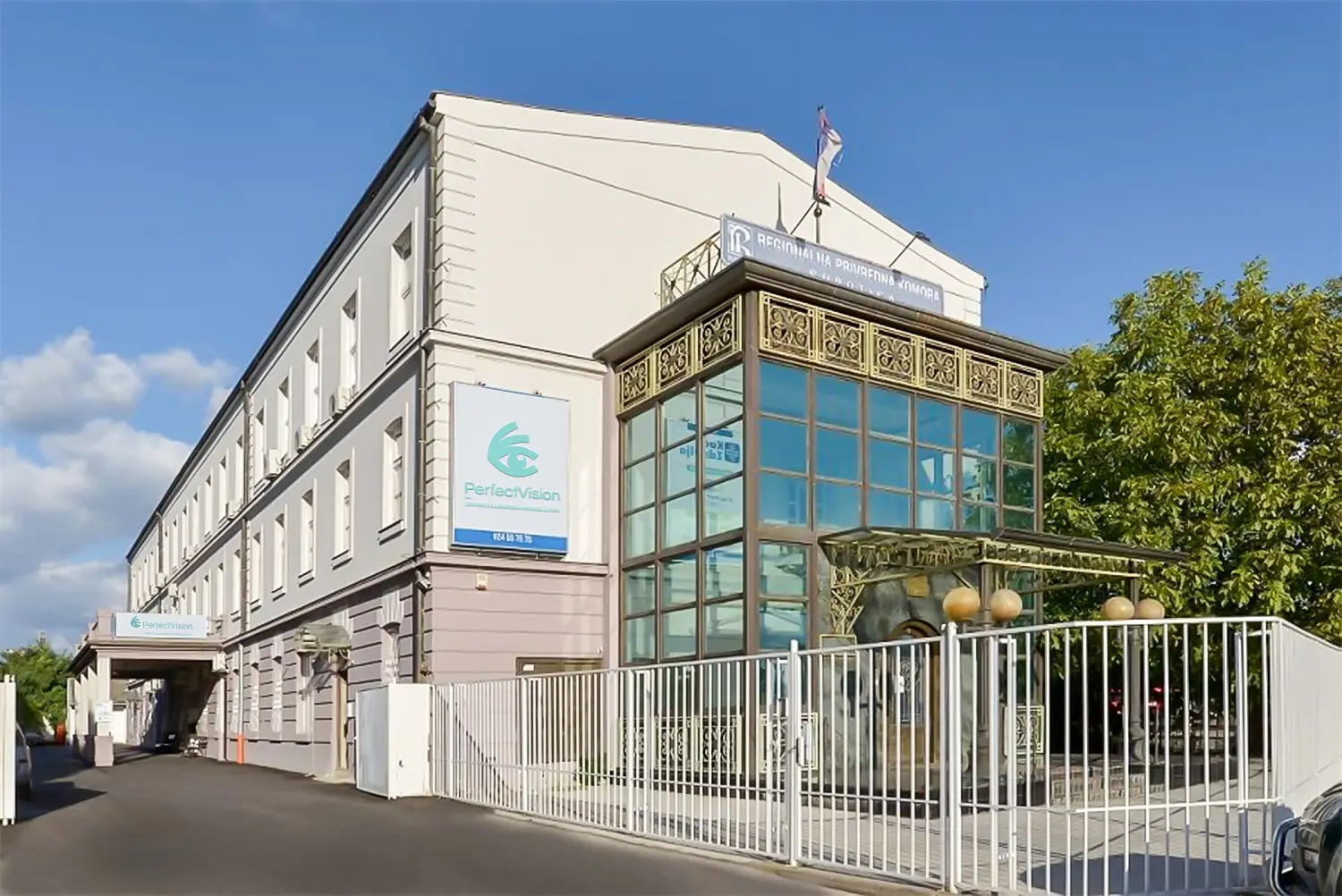


Perfect Vision is a Center for Laser Eye Surgery, located within the Polyclinic House of Health, based in Subotica. Visit us!


We have an ISO certificate according to ISO 9001: 2015, registration number 12 100 59137 TMS for the area of Diagnostic, Conservative and Surgical Ophthalmic Services, issued by the certification body TÜV NORD CERT GmbH.