This text is intended to introduce our patients to a new type of service provided by our clinic, which is the implantation of intraocular lenses that correct astigmatism.
– Astigmatism is a fracture anomaly of the eye that is caused by an irregular curvature of the cornea, so that its curvature is different in different meridians of the eye. As a result, blurred vision occurs.
– Intraocular lenses are artificial lenses that are surgically implanted in the eye, most often during cataract surgery (Figure 1 – Artificial Lens, Figure 2 – position of the lens after implantation in the eye). Lenses become an integral part of the eye, they are not removed, the patient does not feel them and do not have an expiration date.
–Cataract is a clouding of the lens of the eye, a structure of the eye located behind the iris (iris), which causes blurred vision that in most cases cannot be corrected with glasses. The only way to solve the problem of cataracts is surgical removal of cataracts and implantation of artificial lenses in the eye – the so-called intraocular lenses.
In people who have astigmatism and cataracts, it is possible to implant an artificial lens in the eye to get rid of the problem of cataracts and the problem of astigmatism, which is primarily related to corneal anomaly. These lenses are called toric intraocular lenses. If patients with astigmatism implant standard lenses, they will usually receive distance and near-vision glasses, and if they are implanted with toric intraocular lenses, there is a high probability that they will be independent of wearing distance glasses, and will wear only reading glasses.
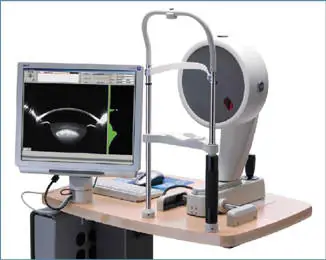
Patients who have this problem undergo a very precise and extensive examination before surgery. Our clinic has diagnostic equipment that rivals the best clinics in Western countries, which is of great importance in the implantation of this type of lens. We have machines that represent the gold standard in this type of surgery in the world (Figure 3 – Penatacam HR – German-made – the leading corneal topograph currently in the world, Figure 4 – LenstarLS 900 – the best optical biometer in the world, the gold standard in calculating the corneal curvature index).
Astigmatism represents a refractive anomaly in which, due to the unequal curvature of the cornea (the front, most prominent, transparent part of the eye), not one, but several focuses of light rays appear. This causes a blurred, unclear vision of the observed object, a deformed image or deformation of the letters when reading the text. Astigmatism can exist independently or can be associated with myopia (short-sightedness) or hypermetropia (far-sightedness). id=”post-carousel-68cf455024f43″>
Astigmatism is very it is often hereditary, appears in childhood and can increase over time. If its continuous growth is observed during regular controls, a disease called keratoconus can be suspected. This condition must be monitored because in most cases it is a progressive disease of the cornea that at a certain point must be treated by strengthening the cornea, the so-called. CXL technique.
There may be congenitally large astigmatisms associated with farsightedness or nearsightedness or independent, which if not corrected in time with optical aids (glasses, contact lenses), can cause permanent low vision.
In order to establish the diagnosis of astigmatism, it is necessary to go to an ophthalmological examination where the ophthalmologist will perform an examination of wide pupils, in order to accurately and objectively determine the size of the refractive error. The light reflection from the surface of the cornea is measured with a device called a keratometer. The curvature of the cornea is measured with special instruments, corneal topography (corneal map) is usually performed.
Astigmatism can be corrected in several different ways.
[nggallery id=“46″]
Perfect Vision is an Eye Laser Surgery Center located within the Kuća zdravlja Polyclinic, headquartered in Subotica.
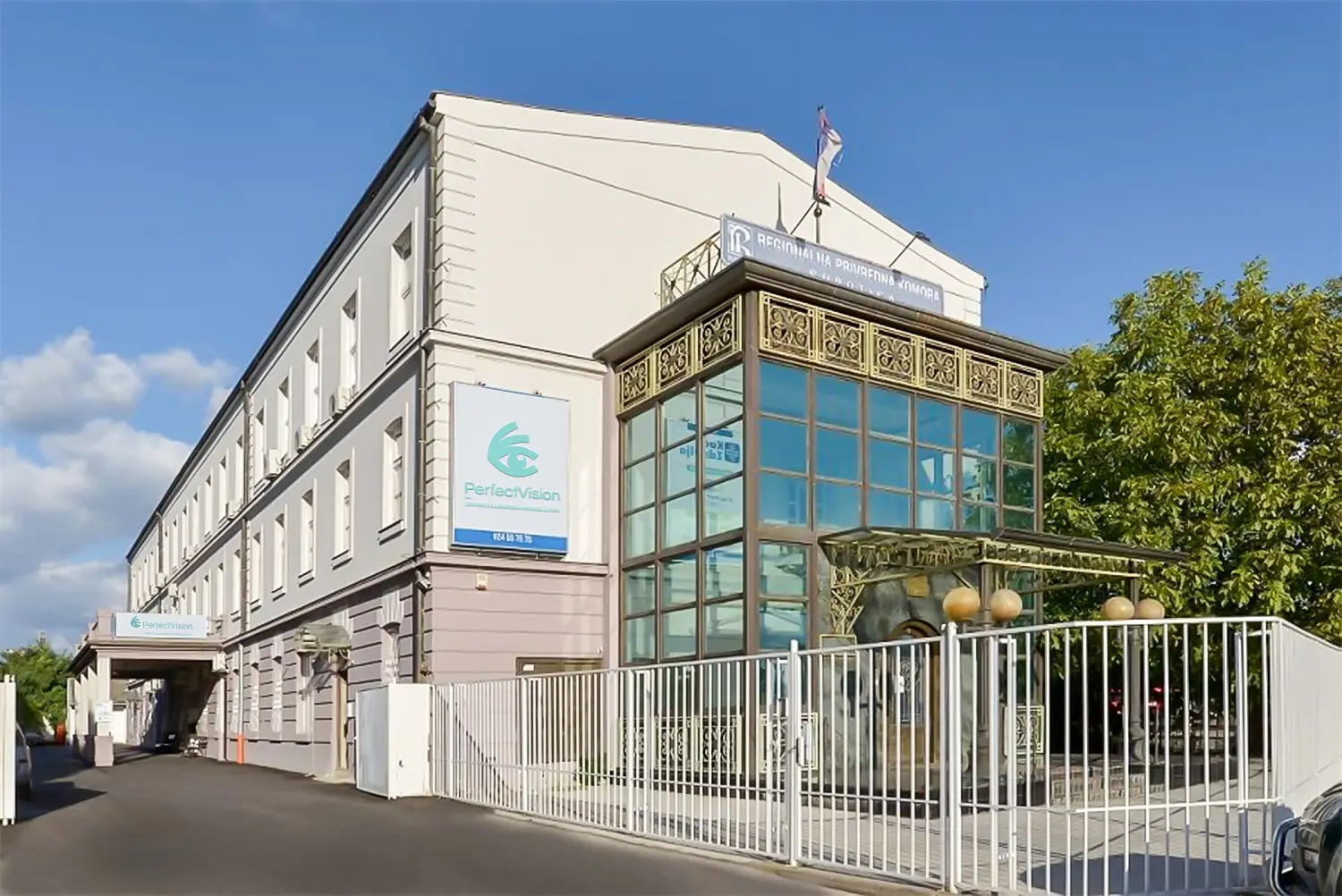


Perfect Vision is a Center for Laser Eye Surgery, located within the Polyclinic House of Health, based in Subotica. Visit us!


We have an ISO certificate according to ISO 9001: 2015, registration number 12 100 59137 TMS for the area of Diagnostic, Conservative and Surgical Ophthalmic Services, issued by the certification body TÜV NORD CERT GmbH.