Meibomian gland expression – the key to the health of your tear film and clear vision
What are Meibomian glands? Meibomian glands are small glands located in the eyelids that produce the lipid (fatty) component of…

Symptoms of senile farsightedness are: blurred and unclear vision when working up close, increased eye strain, headaches (especially in low light), fatigue, distance from text, need for stronger light and larger font.
Persons with normal vision (without refractive error, i.e. dioptres), start to notice the first problems during close work around the age of 45, while farsighted people, i.e. persons with the so-called plus dioptre, they notice these symptoms already around the age of 40. In myopic people, senile farsightedness appears later and at that age it is enough for them to take off their distance glasses and find the distance at which they can read without any correction (mostly this distance is closer than the normal 30-35 cm from the eyes).

To establish a correct diagnosis of presbyopia, it is necessary to perform an examination, which should be performed exclusively by an eye doctor. As part of the examination, in addition to checking the eyesight (diopter), it is obligatory to measure the eye pressure and examine the front segment of the eye and the fundus, which must be done with dilated pupils. It is important to emphasize that presbyopia is a process that progresses over time, and therefore it is necessary to perform regular examinations, every 1-2 years.
Correction of presbyopia can be done in different ways:
Perfect Vision is an Eye Laser Surgery Center located within the Kuća zdravlja Polyclinic, headquartered in Subotica.
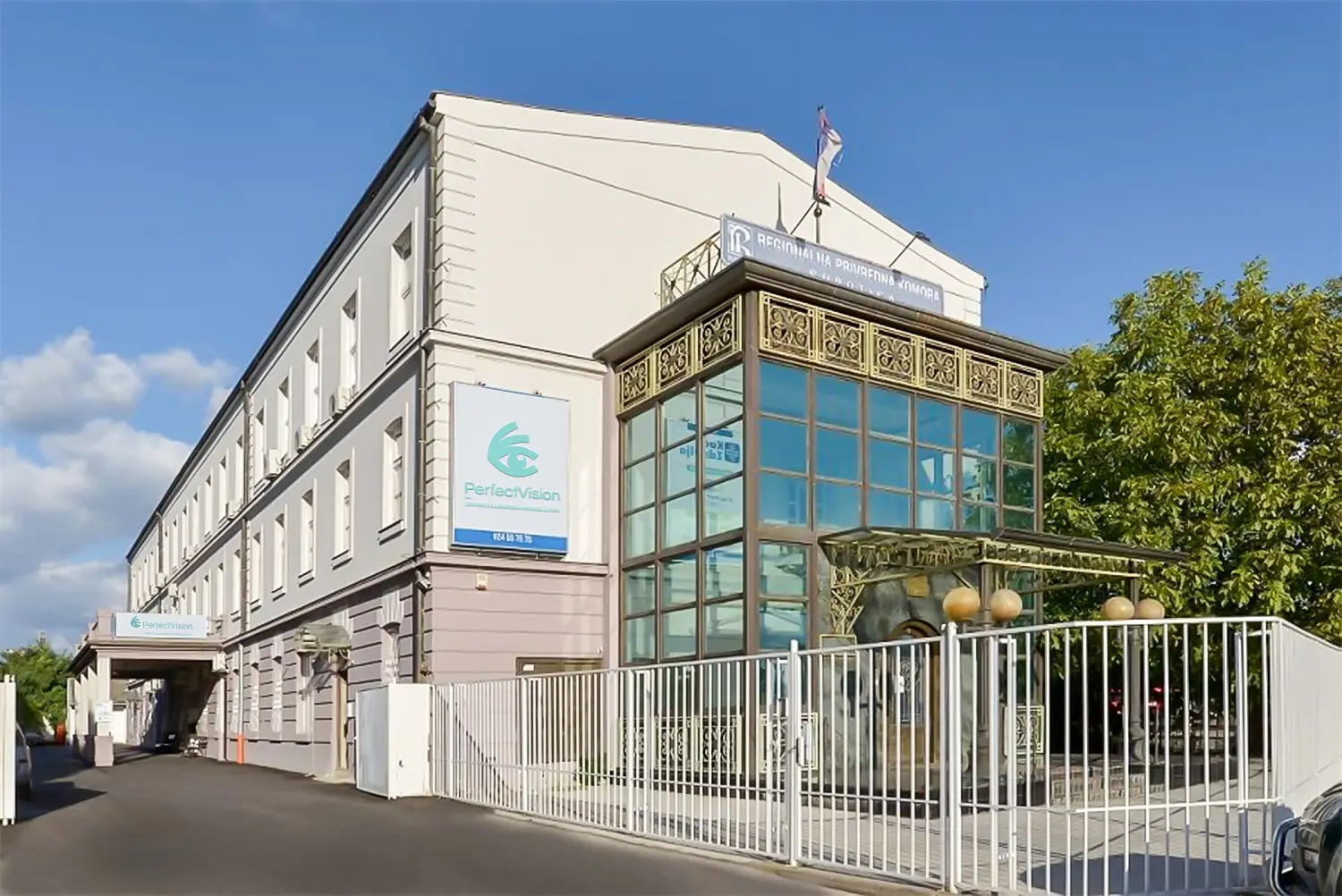


Perfect Vision is a Center for Laser Eye Surgery, located within the Polyclinic House of Health, based in Subotica. Visit us!


We have an ISO certificate according to ISO 9001: 2015, registration number 12 100 59137 TMS for the area of Diagnostic, Conservative and Surgical Ophthalmic Services, issued by the certification body TÜV NORD CERT GmbH.